
There’s a moment most of us know well. You’re sitting in the dental chair, bracing yourself for
that familiar scraping sound, slightly dreading what comes next. The scale and polish has been
around forever – and for most people, it’s perfectly fine. But “fine” isn’t always what you’re after,
is it?
More and more patients in Croydon are discovering airflow teeth cleaning – and honestly, once
you try it, it’s hard to go back. It’s faster, more comfortable, and in many cases. Just a controlled jet of air, water, and fine powder that leaves your teeth feeling genuinely clean.
At iCare Dental Croydon, we offer airflow cleaning as part of our hygiene services, and the
feedback from patients has been really positive. So if you’ve been curious about it – or you’ve
never even heard of it before – this guide covers everything you need to know.
Airflow Teeth Cleaning in Croydon is a modern, gentle alternative to traditional scale and polish—using a stream of air, water, and fine powder to remove stains and plaque quickly, comfortably, and effectively for a smoother, brighter smile.
Airflow is a professional dental hygiene treatment that uses a specially designed handpiece to
deliver a high-pressure stream of warm water, compressed air, and fine erythritol powder directly
onto the surface of your teeth and gums.
That combination works together to blast away:
Airflow cleaning effectively removes plaque and soft debris that build up on the teeth and along the gum line, helping to prevent cavities and gum disease while leaving your mouth feeling fresh and clean.
This advanced cleaning method gently eliminates biofilm, a thin layer of bacteria that can lead to oral health problems if not removed regularly, improving overall gum health and hygiene.
Airflow technology targets and lifts stubborn surface stains caused by everyday habits, restoring the natural brightness of your teeth without damaging the enamel.
Your hygienist will take a look at your teeth and gums, check for any areas of concern, and may measure the depth of the gaps between your teeth and gums (called periodontal pockets). This is painless — it just involves a thin probe and takes a couple of minutes.
This is the question we hear most often, and it’s a fair one.
Traditional scale and polish involves using metal instruments to manually scrape calculus
(hardened plaque) from the surface and between teeth, followed by a polishing step using a
rotating cup with gritty paste. It works well – and for patients with minimal build-up, it may be
all that’s needed.
Airflow, on the other hand, is less abrasive on your enamel. The powder used is fine and gentle,
and the technique removes biofilm and staining without the physical pressure of scraping
instruments. For patients who have sensitive teeth, anxiety around dental sounds, or simply
want a more comfortable experience, it’s often the preferred option.
There’s another difference worth noting. Standard polishing can sometimes struggle to reach
between teeth and just below the gumline effectively. Airflow handles both of these areas much
better, making it particularly useful for patients with periodontal concerns, implants, or
orthodontic brackets.
| Scale & Polish | Airflow Cleaning | |
| Stain removal | Good | Excellent |
| Biofilm removal | Moderate | Thorough |
| Gum line access | Limited | Very effective |
| Comfort level | Varies | Generally higher |
| Suitable for implants | Not ideal | Yes |
| Suitable for braces | Not ideal | Yes |
Unlike traditional scale and polish, airflow cleaning doesn’t rely on metal tools scraping against your teeth. Instead, it uses a controlled stream that feels smooth and comfortable, making the experience far less intimidating.
Airflow is ideal for patients with sensitivity, as it avoids the pressure and friction often associated with manual scaling. The gentle approach reduces discomfort while still delivering excellent cleaning results.
The fine powder used in airflow treatment lifts surface stains from coffee, tea, red wine, and smoking more efficiently, leaving your teeth visibly brighter without harsh abrasion.
While traditional methods focus on hardened plaque, airflow effectively removes biofilm – the soft bacterial layer that forms daily—helping to improve overall oral hygiene and gum health.
Airflow can clean between teeth and just below the gumline more effectively than standard polishing tools, making it a great option for maintaining hard-to-reach areas.
Airflow teeth cleaning may be suitable for a range of patients, depending on their individual oral-health needs and the advice of their dentist or hygienist.
Coffee and tea drinkers — Coffee and tea can contribute to surface staining over time. Air polishing can help remove selected surface stains and biofilm, depending on the type and extent of staining.
Current and former smokers — Tobacco can contribute to stubborn tooth staining. Air polishing may help reduce some surface stains, although results vary depending on the type and extent of staining.
Patients with dental implants — Cleaning around dental implants requires appropriate techniques and instruments. Your dentist or hygienist can recommend a suitable cleaning approach based on the implant and surrounding tissues.
Orthodontic patients — Patients wearing fixed braces may find it more challenging to clean around brackets and wires. Air polishing may help remove selected surface deposits in suitable areas. Patients using Invisalign clear aligners should continue following their dentist’s oral-hygiene advice throughout treatment.
Patients with gum disease — Plaque biofilm can contribute to gum disease. Air polishing may be used as part of a wider periodontal-care plan when clinically appropriate. The dentist or hygienist will assess your gum health and recommend suitable treatment, including periodontal treatment where needed.
Patients seeking additional surface-stain removal — Air polishing may be an option for patients who want help managing selected surface stains and biofilm. Your dentist or hygienist can assess whether it is suitable for your teeth and oral-health needs.
For the vast majority ofpatients – no. In fact, many people find it considerably more comfortable than traditional hygiene treatments.
That said, ifyou have significant gum recession or exposed root surfaces, there may be some sensitivity, particularly to the warm water. Let your hygienist know before the appointment and they’ll adjust accordingly. At iCare Dental Croydon, we always take the time to understand each patient’s comfort levels before we start any treatment.
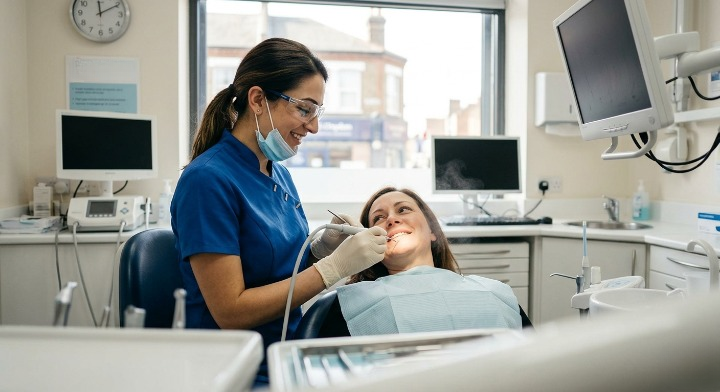
An airflow hygiene appointment typically takes between 45 and 60 minutes, depending on how much build-up and staining is present. Ifwe’re using Guided Biofilm Therapy, we’ll apply a disclosing dye first, which adds a few minutes but gives us a much more targeted and effective clean overall.
It’s worth mentioning that because airflow is so efficient at removing biofilm and staining, follow-up scaling (ifneeded) tends to be quicker – meaning the overall appointment can actually be shorter than a traditional hygiene visit.
The longevity of Airflow cleaning results depends on individual factors, including diet, smoking, home oral hygiene habits and how quickly plaque builds up. The recommended interval between appointments depends on individual oral-health needs and is advised by the dentist or hygienist.
Maintaining good oral hygiene between appointments can help manage plaque build-up and surface staining. The hygienist at iCare Dental Croydon can provide personalised home-care advice, including brushing techniques, interdental cleaning and suitable oral-care products based on your individual needs.
Airflow teeth cleaning is a professional hygiene treatment that uses a controlled jet ofwarm water, air, and fine powder to remove plaque, biofilm, and surface staining from the teeth. It is more comfortable than traditional scraping and is particularly effective at cleaning around gums, implants, and orthodontic appliances.
Most patients find airflow more comfortable than a standard scale and polish. There can be mild sensitivity ifyou have exposed root surfaces or gum recession, but this is manageable. Always tell your hygienist about any sensitivity before starting.
The recommended interval between appointments depends on individual oral-health needs and is advised by the dentist or hygienist. They will assess factors such as gum health, plaque build-up, surface staining and dental implants when recommending an appropriate cleaning schedule.
For removing biofilm, staining, and cleaning around implants or braces, airflow generally performs better. For heavy calculus build-up, a combination approach may be used – airflow first, then targeted scaling where needed
Yes, we offer Airflow teeth cleaning in Croydon as part of our advanced dental hygiene services.
iCare Dental Croydon is centrally located and regularly sees patients from across the local area — including South Croydon, East Croydon, Purley, Thornton Heath, Addiscombe, Shirley, Norwood, Selsdon, and Waddon. If you’ve been searching for “teeth whitening near me” in the CR0 postcode or surrounding areas, our practice is convenient to reach with flexible appointment times.
We welcome both new and existing patients for whitening consultations — you don’t need to be an existing patient to book.
Same-week appointments available. Serving Croydon, CR0 & surrounding areas.
WhatsApp us
iCare Dental has made things easier for you! You can stop asking people, “Which dental clinic is near me?”