What is a dental check-up?
A dental check-up is a routine examination in which a dentist checks your teeth, gums and mouth for decay, gum disease, mouth cancer and other problems, X-rays are taken only when clinically needed, and if treatment is recommended you should receive a written plan before anything starts.
If it’s been a while since your last visit, or you’ve recently moved to E16 and haven’t found a dentist yet, this guide explains each stage so you know exactly what to expect. When you’re ready, you can book a dental check-up in Royal Docks at iCare Dental, a short walk from Royal Victoria DLR.
Why do you need a dental check-up if nothing hurts?
You need regular dental check-ups because most dental problems are painless in their early stages. Decay can develop between teeth or under an old filling, gums can begin to recede and grinding can wear down enamel, all without any discomfort.
Some dental problems can develop without obvious symptoms. Regular check-ups can help your dentist identify potential concerns and discuss suitable treatment options before symptoms develop or worsen. A check-up can help identify potential problems earlier, when treatment may be simpler. and it gives you a chance to ask about anything you’ve noticed, such as sensitivity, bleeding gums or a tooth that looks darker than the others.
What does a dental check-up include? Step by step
A dental check-up may include several stages, depending on your oral health, medical history and individual needs. Your dentist will explain which examinations are appropriate for you.
Step 1 – Medical and dental history
Your dentist asks about your general health, any medication you take and any changes since your last visit. Some medicines cause a dry mouth, which raises the risk of decay, and conditions such as diabetes are closely linked to gum health. This is also the moment to mention pain, sensitivity or any worries.
Step 2 – Examination of every tooth
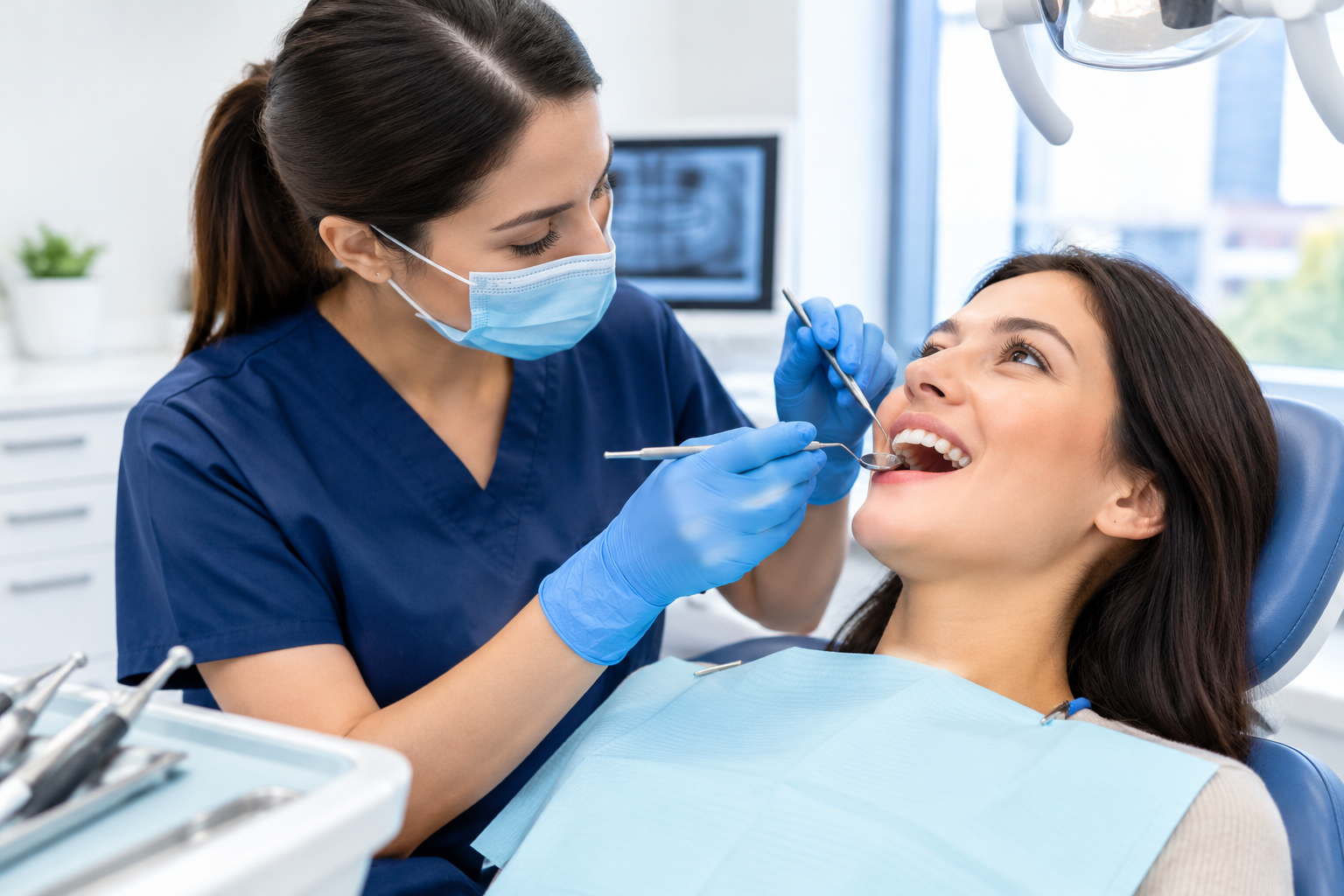
The dentist checks every surface of every tooth with a small mirror and probe, looking for decay, cracks, worn enamel and the condition of existing fillings, crowns and bridges. Flattened or chipped edges can be a sign that you grind your teeth at night.
Step 3 – Gum health check
Using a fine, blunt probe, the dentist gently measures the small gap between each tooth and the gum around it. Deeper gaps and bleeding are early signs of gum disease, one of the most common causes of tooth loss in adults. Caught early, it is very manageable; if it has progressed, your dentist can talk you through gum disease treatment options.
Step 4 – Mouth cancer screening
Your dentist may examine the soft tissues of your mouth, including your tongue, cheeks, lips and the floor of your mouth, as part of your oral assessment. Tell your dentist if you notice a persistent ulcer, lump or unusual patch. Smoking and heavy drinking increase the risk, but mouth cancer can affect anyone, which is why screening is part of every check-up.
Step 5 – X-rays, only when needed
Some problems, such as decay between teeth or under fillings, cannot be seen with the naked eye. Small dental X-rays show them clearly. You won’t need X-rays at every visit; how often depends on your risk. Digital X-rays use a very low dose, but always tell your dentist if you are or might be pregnant.
Step 6 – Bite and jaw check
Your dentist may check how your teeth meet and whether your jaw clicks, aches or feels stiff. These can point to grinding or clenching, which can be managed before it damages your teeth.
Step 7 – Results and your treatment plan
Finally, your dentist explains what they’ve found in plain English. If everything is healthy, you agree when to come back. If treatment is recommended, you should receive a written treatment plan setting out your options and costs, with no pressure to decide on the day.
At a glance: what your dentist checks and why
| Check | What the dentist looks for | Why it matters |
| Teeth | Decay, cracks, worn enamel, failing fillings | Small problems are quicker and simpler to fix |
| Gums | Bleeding, pocket depth, recession | Gum disease is a leading cause of adult tooth loss |
| Soft tissues | Lumps, ulcers, red or white patches | Early detection of mouth cancer |
| X-rays (if needed) | Hidden decay, bone levels, infection | Shows what can’t be seen by eye |
| Bite and jaw | Clicking, wear, clenching | Prevents damage from grinding |
Dental check-up vs hygiene appointment: what’s the difference?
A dental check-up is an examination and diagnosis by a dentist, while a hygiene appointment is a professional clean by a hygienist. Many people benefit from both, and they can often be booked back to back so you only make one trip.
| Dental check-up | Hygiene appointment | |
| Carried out by | Dentist | Dental hygienist |
| Purpose | Examine, diagnose and plan | Clean and prevent gum disease |
| What happens | Teeth, gum and mouth cancer checks; X-rays if needed | Removes tartar and staining; scale and polish; home-care advice |
| How often | As recommended by your dentist, based on your individual oral health needs. | As recommended by your dentist, based on your individual oral health needs. |
How often should you have a dental check-up?
Adults should have a dental check-up recommended by your dentist, based on your individual oral health needs. That range comes from NICE guidance on dental recall, which says the interval should be set by your dentist based on your individual risk, not automatically every six months.
Your dentist may recommend shorter intervals if you:
- have had gum disease or several fillings recently
- smoke or use other tobacco products
- have diabetes or a condition that affects your immune system
- often have a dry mouth
- wear braces, aligners, implants or dentures
If your mouth is healthy and stays that way, longer gaps between check-ups are perfectly reasonable.
What happens if you haven’t been to the dentist in years?
If you haven’t been to the dentist in years, your first appointment may take longer because your dentist may need more time to review your dental and medical history and assess your oral health. X-rays are recommended only when clinically appropriate, so the dentist has a complete picture. You’re far from alone: moving house, a busy job or a bad past experience are all common reasons people drift away.
A good practice won’t lecture you. If several things need doing, they should be prioritised, with anything urgent first and the rest planned at a pace that suits you. If you feel nervous, say so when you book. Agreeing a simple stop signal, such as raising your hand, makes a real difference.
How should you prepare for a dental check-up?
- Bring a list of your medication, including inhalers and supplements.
- Note down any concerns, such as sensitivity, bleeding or a tooth that feels different.
- Brush and floss as normal. There’s no need for a special deep clean beforehand.
- Arrive ten minutes early if you’re a new patient, to complete your forms.
- Bring previous dental records if you have them. Recent X-rays can sometimes save repeating them.
When is it an emergency rather than a check-up?
If you have severe toothache, facial swelling or a dental injury, contact a dental practice promptly to discuss urgent care and appointment availability. If swelling affects your breathing or swallowing, or you develop other signs of a serious emergency, seek emergency medical help immediately.If swelling is affecting your breathing or swallowing, or spreading towards your eye or neck, go to A&E or call 999.
Where can you get a dental check-up in Royal Docks?
iCare Dental provides dental check-ups at Unit A2, Gateway Tower, 30 Western Gateway, Royal Docks, London E16 1YL. The practice is a short walk from Royal Victoria DLR and one stop from Canning Town, making it easy to reach from Custom House, Silvertown, Royal Wharf and the wider E16 area.
All of our dentists are listed on the General Dental Council register, and the practice is registered with the Care Quality Commission. Confirm the current Royal Docks opening hours with iCare Dental before publication. If confirmed, use a clear statement such as: “Appointments are available Monday to Saturday, with extended opening hours until 8 pm on Wednesdays. If you’re looking for a dental check-up near Canning Town, book online or call 0207 993 2595 and we’ll find a time that works for you.
Frequently asked questions about dental check-ups
What does a dental check-up include?
A dental check-up includes a review of your medical history, an examination of every tooth, a gum health check, a mouth cancer screening, X-rays if clinically needed, a bite and jaw check, and a clear explanation of any findings with a written plan if treatment is recommended.
How long does a dental check-up take?
A routine dental check-up often takes around 20 to 30 minutes, although the duration can vary depending on your needs and whether you are attending for the first time. A first visit at a new practice can take a little longer because the dentist is building a full picture of your teeth, gums and dental history.
Does a dental check-up hurt?
No. A dental check-up is an examination, not treatment. You may feel the probe touch your gums, especially if they are inflamed, but it should not be painful. Tell your dentist if you feel anxious so they can explain each step.
Do I need X-rays at every dental check-up?
No. Your dentist recommends X-rays based on your individual risk of decay and gum disease. Patients at lower risk need them less often, while people with recent decay or gum problems may need them more regularly.
Can I book a dental check-up if I haven’t been to the dentist in years?
Yes. Mention it when you book so the team can allow extra time. Your dentist will assess your teeth and gums, prioritise anything urgent and plan any remaining treatment at a pace that suits you, without judgement.
Will my teeth be cleaned at a dental check-up?
Not usually. A check-up focuses on examination and diagnosis. A professional clean, or scale and polish, is a separate hygiene appointment with a hygienist, although the two can often be booked on the same day.
What should I ask at my dental check-up?
Useful questions include: Are my gums healthy? Is there any early decay? When should I come back? Do I need a hygiene appointment? Is there anything I should change in how I brush or clean between my teeth?